The Silence Behind DeepSeek
DeepSeek’s silence hides a strategic layout that may be more exciting than the V4 large model. From a full-chain talent reserve for agents to building its own computing power base, the company is constructing a complete intelligent product ecosystem. While the industry chases parameter competitions, DeepSeek might be brewing a true AI product revolution—upgrading from conversational AI to task-executing agents.

Recently, Hu Yanping, a distinguished professor at Shanghai University of Finance and Economics, sent a letter titled “The Last Urge for DeepSeek to Update”. This letter reflects the current sentiment of many: both eager and impatient.
Earlier this year, the market was buzzing about the arrival of V4. However, it didn’t come in February or March, and now there’s talk of an April release, but the reaction on social media has shifted from “anticipation” to “oh”.
While other companies are busy with large model announcements, feature releases, and presentations, DeepSeek remains silent.
Everyone is asking: What is DeepSeek up to?
I was curious too. So, I recently checked job postings to see what positions DeepSeek is hiring for and what they might be working on.
The Real Interest Beneath V4
First, let’s talk about V4.
It is certain that it will come. There are already signals of multimodal gray testing, agent capabilities are a confirmed direction, and the price for million tokens continues to drop.
But that’s not the main point I want to discuss.
Have you noticed something? Over the past year, various large models have been racing against each other, refreshing parameters, rankings, and release events, yet the general sentiment is that while they are usable, they lack a significant sense of disruption. (In fact, the impact of the overseas “shrimp” was stronger.)
When you open any AI assistant and ask it to write a proposal, look up information, or create a script, it can provide a seemingly decent answer—but do you really use its output directly? Most of the time, you still need to modify, verify, and reorganize; AI merely saves you some effort.
Why is that? Is it because the large model capabilities are lacking? Yes and no. The bottleneck today is not the model capabilities themselves.
The real bottleneck lies in the output: no matter how strong the model is, if there isn’t a good product to support it, users won’t perceive its value, making everything pointless. (The “shrimp” phenomenon is an example; OpenClaw’s popularity essentially reflects the application of model capabilities at the product level.)
V4 is just a model; the real question is where the model’s output lies.
I personally believe DeepSeek understands this better than anyone.
During its period of silence, it may not have been “waiting” but rather continuously upgrading model capabilities and adapting to domestic chips while also figuring out: After releasing V4, what will it use for productization?
Insights from DeepSeek’s Hiring Trends
Some may question, how can you think this? How did you come to this conclusion?
It’s simple: look at who they are hiring. When a company starts hiring a lot of people in a specific direction, it usually indicates what they are planning to do.
I reviewed DeepSeek’s recent job postings (as of mid-April), and several signals emerged that, when combined, are quite interesting.
First Signal: Agents—Betting on the Entire Chain
On March 24, DeepSeek posted 17 job openings related to agents all at once—algorithm researchers, data evaluation experts, infrastructure engineers, and strategy product managers. This is not a posture of “exploring directions”; it’s about building a complete production line.
Moreover, a detail worth noting is that several positions list as a plus: “Heavily using AI programming tools like Claude Code, Cursor, Copilot, etc., is preferred.” The responsibilities for the agent full-stack engineer even mention being a “heavy user of Vibe Coding”.
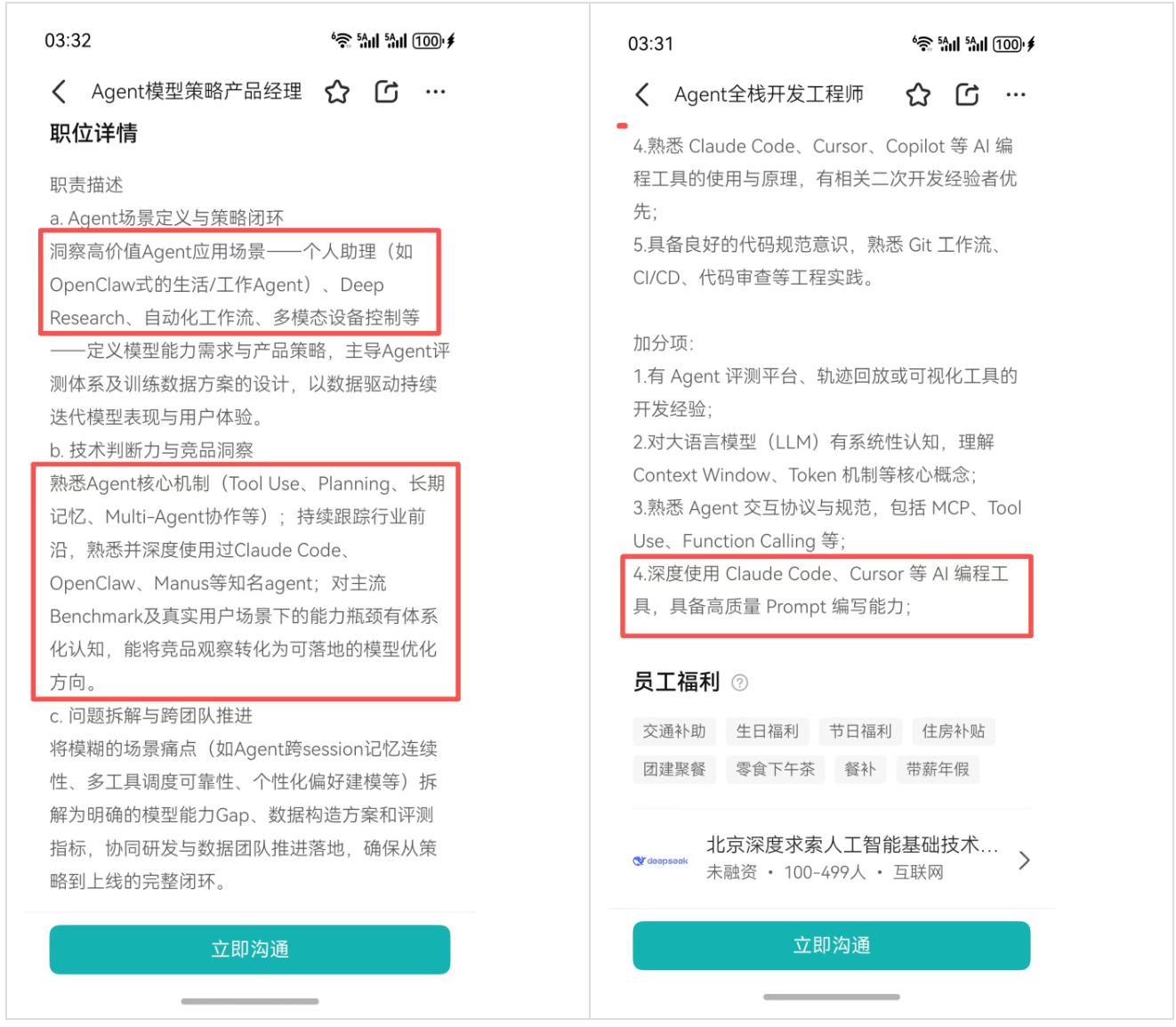
DeepSeek is not looking for “people who understand AI”; it’s looking for “people who work in an AI-driven way”. This hiring standard itself subtly hints at what it plans to do next.
Second Signal: Search—An Earlier Laid Hidden Line
Many have overlooked this line. As early as January this year, Bloomberg reported that DeepSeek was hiring for multilingual AI search engine developers, aiming to create a multimodal search product capable of processing text, images, and audio, competing with Google and OpenAI.
Search is the most challenging AI product to develop but has the strongest user stickiness. DeepSeek has quietly laid this groundwork for a long time, and it’s only now being noticed.
Third Signal: Inner Mongolia—First Hiring for Offline Data Center Positions
This latest signal is the most easily overlooked. In April, DeepSeek announced job openings for data center operations engineers and delivery managers in Ulanqab, Inner Mongolia.
If I recall correctly, this should be DeepSeek’s first public hiring for offline infrastructure roles.
When a large model company starts hiring for data center operations, what does it mean? It means they are seriously preparing to build their own computing power—not relying entirely on existing “Firefly series self-built computing clusters” from Huansquare, but formally establishing a dedicated “computing factory” for the upcoming trillion-parameter V4 model (and future higher versions). This also indicates that DeepSeek is preparing to tackle future competition through both algorithm optimization and infrastructure support.
Looking at these three signals together: agent full chain, multimodal search entry, self-built computing power base—this is not a scattered hiring action; it’s a company quietly building a complete product foundation.
Currently, DeepSeek’s app is still quite basic. It essentially connects to a large model and provides a search box; multimodal features are not officially launched, there’s no agent capability, and nothing particularly indispensable. It feels more like a “high-end search engine” rather than a true AI agent.
So, speaking of this, we can boldly predict that what will be launched alongside V4 may not just be a “smarter dialogue box”.
If that’s the case, it would differ significantly from the approaches of other domestic companies. While others are focusing on large model hype, API price cuts, and application layer shells,
DeepSeek is pondering whether it can create a truly effective intelligent product that helps users accomplish tasks beautifully. (Could the Chinese version of the original “shrimp Plus” or Claude Code come from DeepSeek? It’s truly worth anticipating.)
This difference will determine how far it can go next.
Why I Continue to Use DeepSeek
Let’s get back to my personal experience over the past two years.
I use DeepSeek not because of the “strongest model” label.
I use it because it has proven to be relatively reliable in my daily business scenarios.
For example, in recent months, I have been assisting a group of trainees in IP incubation. To help them produce content more efficiently, I customized a systematic prompt for them—trainees first input this prompt into the AI, then send their spoken recordings, and the AI can organize and output a compliant video script that can be directly used for recording.
In this process, trainees do not need to write scripts themselves, as not everyone has excellent writing skills; however, it’s much easier to express their thoughts verbally into a phone.
Note that I required the trainees to use DeepSeek for this prompt, not Doubao.
Why?
Because the content generated by DeepSeek is more usable, has better logic, and fewer hallucinations. This conclusion is not just from my own tests but from repeated use and feedback from the trainees.
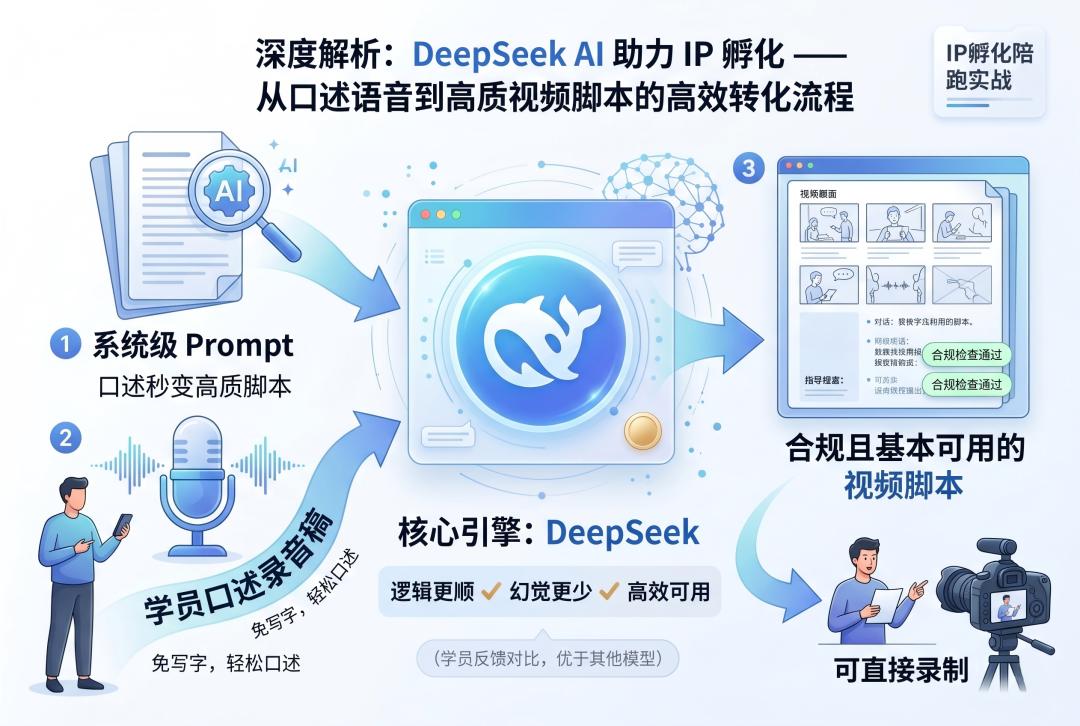
Of course, Doubao is not unusable (its search scenarios and user-friendly voice features are impressive), but in some business contexts, its output stability is not as good as DeepSeek’s.
This gap may seem small, but in actual business delivery, it makes a big difference.
Among domestic models, I use DeepSeek the most, not because it’s the hottest, but because it’s relatively more suitable for what I’m currently doing.
In short, its model foundation is already solid enough, and the launch of V4 is basically no longer in doubt. What’s lacking is a truly usable product to support it. This is why I believe DeepSeek’s efforts in consumer products are worth serious anticipation.
AI is Transitioning from “Dialogue” to “Execution”
Finally, let me share my personal judgment.
In Professor Hu Yanping’s urging letter, he mentioned that DeepSeek’s silence over the past year has caused it to miss several waves of trends.
But I believe that missing is not failure; it’s a choice.
DeepSeek is waiting for a window—not the window for launching V4, but the window for product development.
The upcoming competition in AI will not just be about “whose large model is the strongest” but about whose product can truly help users accomplish tasks beautifully.
Everyone has conversational AI now.
The next battleground for the domestic AI industry will be efficient, autonomous execution AI tools.
V4 will come, and agents will come.
What’s truly worth watching is not when it launches but how it can help us accomplish tasks beautifully afterward.
Alright, I’ll continue using DeepSeek.
Comments
Discussion is powered by Giscus (GitHub Discussions). Add
repo,repoID,category, andcategoryIDunder[params.comments.giscus]inhugo.tomlusing the values from the Giscus setup tool.