Introduction
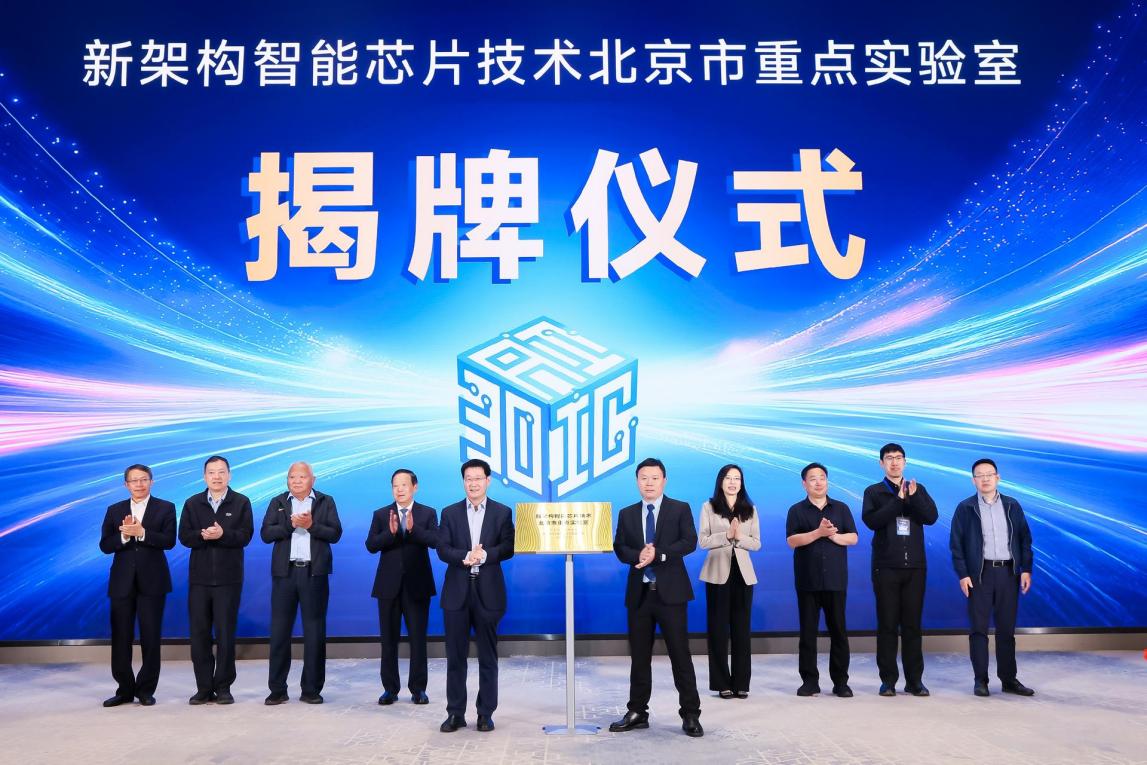
On May 17, the 2026 (first) AI Academician Forum themed “Leading Chip Power, Creating the Future” was held in Beijing, alongside the establishment ceremony of the Key Laboratory for New Architecture Intelligent Chip Technology.
Currently, the integration of artificial intelligence and integrated circuit technology is accelerating, making chip architecture innovation a significant development direction in the global tech field. This forum gathered representatives from government, industry, academia, and research to discuss topics such as the transformation of computational infrastructure and breakthroughs in core technologies, aiming to build consensus for the collaborative development of the computing industry and AI technology.
 2026 AI Academician Forum site
The forum was guided by the Beijing Municipal Science and Technology Commission and the Management Committee of Zhongguancun Science Park, hosted by the Key Laboratory for New Architecture Intelligent Chip Technology, and organized by Qingwei Intelligence, the Software Research Institute of the Chinese Academy of Sciences, Beijing University of Technology, and the Beijing Academy of Artificial Intelligence.
Strategic Layout and New Research Platform
During the opening ceremony, attendees proposed ideas and suggestions for the development of the AI and integrated circuit industries. Liu Xiaofeng, Vice Chairman of the 12th National Committee of the Chinese People’s Political Consultative Conference, highlighted four directions in his speech: focusing on core technology to form collaborative teams for breakthroughs; promoting AI to empower the real economy; adhering to open collaboration to build a mechanism for the integrated development of technology, industry, and finance; and improving the AI governance system to promote safe and standardized technological development.
 Zhang Jihong, Director of the Beijing Municipal Science and Technology Commission and Zhongguancun Management Committee
Zhang Jihong introduced that Beijing ranks among the top in the country in terms of talent resources and core industry scale in the AI field. The establishment of the Key Laboratory for New Architecture Intelligent Chip Technology marks an important layout for regional computing technology research and development, leveraging the advantages of coordinated development in the Beijing-Tianjin-Hebei region to drive industrial upgrades through technological innovation.
 Wang Bo, Founder, Chairman, and CEO of Qingwei Intelligence
Wang Bo stated that the scale of China’s AI core industry has exceeded 1.2 trillion yuan, and it is expected to surpass 10 trillion yuan by 2030. The forum aims to assess industry trends and exchange cutting-edge achievements, working together to bridge the “last mile” from technological innovation to industrial innovation.
At the event, the Key Laboratory for New Architecture Intelligent Chip Technology was officially unveiled, with seven experts including Qian Depai and Li Keqiang appointed as members of the laboratory’s academic committee, marking a new stage of systematic and specialized research in the field of new chip architecture.
Cutting-Edge Discussions and Expert Insights
The keynote report session was hosted by Ouyang Peng, Director of the laboratory and CTO of Qingwei Intelligence. Several experts shared their cutting-edge research results, exploring the development paths of intelligent chip technology from different dimensions.
Academician Qian Depai from the Chinese Academy of Sciences proposed promoting computing power development through the integration of computing networks and intelligent computing, advocating for the development of computing systems that combine general and specialized capabilities. He emphasized enhancing computing power performance through advanced integration technologies and promoting the universal and public development of computing resources. Academician Li Keqiang from the Chinese Academy of Engineering focused on the intelligent automotive sector, systematically elucidating key technologies for foundational computing platforms, and constructing a technical base by integrating chips, operating systems, and functional software to drive the development of an integrated technology ecosystem for vehicles, roads, and clouds.
Zhu Xinkai, Executive Vice President of Renmin University of China, explored new research models in philosophy and social sciences in the AI era from the perspective of cross-disciplinary integration, proposing to promote deep collaboration between humanities, social sciences, and AI technology to provide theoretical support for technological innovation.
Industry Implementation and Technological Achievements
In the afternoon, the New Architecture Intelligent Chip Industry Forum was held simultaneously, hosted by Wu Yanjun, Deputy Director of the Software Research Institute of the Chinese Academy of Sciences. Experts shared technological breakthroughs and industrial practice results around key areas such as chip design, processor ecosystems, software systems, and terminal applications.
Researcher Wu Nanjian from the Semiconductor Research Institute of the Chinese Academy of Sciences introduced the progress of the all-pulse visual system development, optimizing brain-like visual chip performance based on mature CMOS technology. Deputy Director Bao Yungang from the Institute of Computing Technology of the Chinese Academy of Sciences shared applications of open-source processor technology, leveraging the advantages of the RISC-V architecture to support large-scale computing scenarios. The Beijing Academy of Artificial Intelligence launched an open computing ecosystem platform, achieving compatibility with multi-chip architectures and support for large model applications. Professor Chen Zhijie from Beijing University of Technology showcased a low-power intelligent visual chip solution, providing technical support for edge intelligent applications.
At the forum, Frost & Sullivan released the “New Computing Power Chip and Future Key Technology Development Report 2026,” assessing the domestic AI computing power chip market size and technology development trends, analyzing the development patterns of diverse technological architectures, and proposing directions for the commercialization of the industry.
Ecosystem Co-Building and Clear Development Paths
In the roundtable dialogue session, guests exchanged views on the innovation of new architecture intelligent chips and the construction of a full-link ecosystem, discussing topics such as software ecosystem development, computing power communication interconnection, architecture optimization upgrades, and application scenario-driven strategies. Concurrently, the first meeting of the laboratory’s academic committee clarified the laboratory’s technological research and development direction, focusing on breakthroughs in new architectures and technology validation, promoting innovative research in computing paradigms.
The successful hosting of this forum established an important platform for collaboration and exchange between the fields of artificial intelligence and intelligent chips, promoting the deep integration of cutting-edge technology research and industrial practice. With the newly established Key Laboratory in Beijing as a foundation, the technological breakthroughs in new architecture intelligent chips will continue to advance, providing solid support for the high-quality development of the computing industry and the widespread application of AI technology.
Comments
Discussion is powered by Giscus (GitHub Discussions). Add
repo,repoID,category, andcategoryIDunder[params.comments.giscus]inhugo.tomlusing the values from the Giscus setup tool.