The Dream of ‘Everyone is a Programmer’ Should End
The concept of ‘vibe coding’ has become one of the hottest topics this year. However, from the rapid rise of ‘quickly assembling applications using LLMs’ to its noticeable decline within six months, the tide is clearly turning.
The most direct manifestation of this is the significant drop in user traffic across all products. Lovable, for instance, saw its traffic plummet from 35 million to under 20 million, nearly halving. Other star products like Bolt.new and Vercel v0 have also experienced declines of 27% and 64%, respectively. Platforms such as Cursor, Replit, and Devin have not escaped this trend, with the only exception being Base44, which still relies on advertising.
Even the CEO of Bolt.new publicly acknowledged that “all platforms are experiencing very high user churn rates” and emphasized the urgent need to build a business model that retains users.
In the past year, the industry experienced a capital-driven “hyper-growth phase,” with company valuations and user numbers soaring. However, as the hype quickly recedes, we may be witnessing a true return to value.
The Cost of Trial and Error
If we were to draw a genealogy of current AI programming tools, Lovable undoubtedly occupies a prominent position. It started in late 2023 in Sweden with a simple slogan: “Describe what you want, and watch the software come to life.”
Its growth has been almost dreamlike: it claimed to surpass $100 million in annual revenue in its first year and built over 10 million projects. Subsequently, it completed Series A funding at an $1.8 billion valuation, with rumors of its valuation soaring to $4 billion shortly thereafter, making it one of Europe’s hottest AI projects.
Following this, products like Bolt, Replit, and V0 emerged, igniting a wave of “natural language development.”
Behind all this is a marketing narrative that precisely targets human weaknesses. As some observers pointed out, the videos showcasing “cloning any app in minutes and starting to make money” sell not technology but a fantasy of “low investment = immediate profit,” providing a glimpse of programming to those who do not understand code.
However, if we consider who represents the original experience of “vibe coding” in the eyes of professional developers, it is undoubtedly Claude Code. It does not emphasize making every line of code visible but intentionally hides the code in the background, guiding developers to focus on terminal dynamics, creating an immersive experience where “AI is working for you.” This establishes a collaborative paradigm of “task delegation - background execution”: Agents act as independent entities capable of completing tasks, planning, and iterating until the job is done, including generating and submitting code while humans can step away.
In contrast, GitHub Copilot and Cursor represent another path in the AI coding tool genealogy. They function more as “AI programming assistants” within serious engineering systems, focusing on completing, refactoring, and writing tests without aiming for one-click generation of complete applications, allowing engineers to retain control over the pace and decision-making.
This has led to two diverging paths: one is “asynchronous agent-style vibe coding,” and the other is “human-led serious engineering collaboration.” The latter is clearly more likely to gain long-term recognition and paid subscriptions from professional developers.
The Myth of 35 Million Users
Lovable’s claimed 35 million monthly active users nearly approaches the total number of professional developers worldwide, estimated at just over 40 million. This suggests that its peak users are not programmers but rather those “wanting to become developers” or hoping to “quickly solve development tasks”—such as product managers, students, and creators.
Zhang Hailong, founder of GBOX.AI, reflects on this wave, stating: “The hype around Vibe Coding earlier this year was essentially a trend, like a fashion item. Everyone tried it, but almost no one renewed their subscription into the second month.”
This type of C-end “vibe coding” product fundamentally faces issues of demand rigidity. He compares it to the difference between “professional photography and smartphone photography,” pointing out that while everyone has a need to capture and share life through photos, writing software does not align with basic human desires.
“Some things won’t be used even if the threshold is lowered to zero,” he emphasizes, “because it doesn’t meet basic human emotions and needs.”
Supporting this mass experiment are billions of dollars in capital. As investor Theo pointed out, “Lovable is valued at tens of billions because people like me invested money; they are using this money to subsidize computing power and build a platform that allows ‘12-year-olds’ to play with ‘cool code generation tools.’” However, the game of capital has its limits, and real user retention is the true test; these users will “99 out of 100 disappear when they find it boring.”
In contrast, vibe coding aimed at professional developers presents a different situation. Developers do not face demand rigidity issues; AI tools can indeed enhance efficiency, and developers can stand behind the results.
However, he also points out a harsh reality: “This story also cannot support the current valuation of Vibe Coding.”
More importantly, the battlefield is escalating. Currently successful platforms like Claude Code and Cursor are “actually developing their own models.” He specifically mentions, “Cursor is being forced down this path; otherwise, it lacks competitiveness.”
“For professional audiences, it heavily relies on models, which is a business for large companies.” He further predicts, “The final competitors in the global developer market will not exceed five. Among startups, only Cursor has a chance, as it was the earliest to start. Of course, open-source models might also secure a place, but this is no longer a game that ordinary startups can easily participate in.”
Similar narratives are unfolding globally and domestically.
Zhang Hailong notes, “The domestic hype peaked earlier this year; all investors were asking about Vibe Coding, reflecting the market’s FOMO at that time. However, the trend came quickly and left just as fast; mainstream investors now seem to be uninterested in Vibe Coding projects.”
This sudden rise and fall is not an isolated case. He cites MCP as an example, where the concept once sparked investor interest due to social media buzz, with many projects raising funds, “but in reality, they did not generate long-term, valuable revenue.”
Is It Coming to an End?
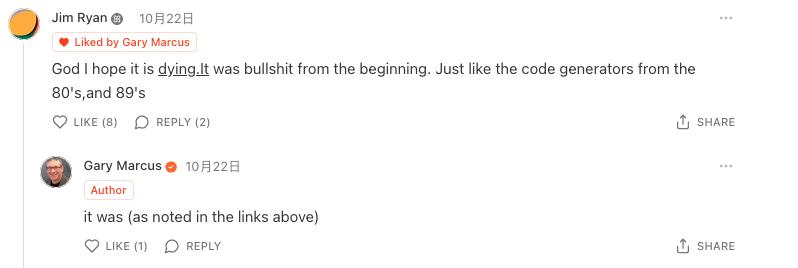
Amid the continuous decline in traffic, social media sentiment towards Vibe Coding is also rapidly accumulating fatigue and resentment. Scholars and commentators like Gary Marcus have recently issued extreme criticisms of Vibe Coding programming, with Marcus even liking a comment that expressed a desire for it to “disappear quickly; it has been nonsense from the start.” Such sentiments have repeatedly surfaced in recent months—across various technical discussions, one can sense a rapidly diminishing patience among both practitioners and ordinary users towards “vibe coding.”
However, some still believe that these tools are worth pursuing as a “dream.”
Investor Theo is a typical representative. He admits that he does not actually support targeting non-developers: “Never sell products to ‘potential’ users; sell to ‘real’ users. This is a pitfall many have fallen into. Therefore, products like Cursor (which I also invested in) are more likely to survive the cycle, while Lovable is in greater danger.”
Even so, he chooses to invest—because he believes these tools can allow more people to experience the moment of “Oh wow, it actually works!” even if 99% ultimately give up. “Even if they burn billions of dollars just to attract a small group of people—that’s still good.” In Theo’s view, “graduating from Lovable” could even be a pathway to genuine development skills, similar to how Flash and Roblox inspired a generation. “Even if they eventually disappear, it would be better if they don’t die; I want to earn back my investment.”
The real challenge lies in the foundational infrastructure required to realize this dream, which remains in its early stages. Xia Lixue, co-founder and CEO of Wumeng Xinqiong, provides a direct assessment: the issue is not the model but the engineering system. Today’s AI programming process resembles “drawing blind boxes”; you throw in a requirement, and the system gives you a result. If it’s not quite right, you have to try again, sometimes even “drawing” ten times simultaneously to select the most usable one. The public’s expectation of “no-code programming” is to generate a complete program in one step using natural language, but the reality involves frequent iterations and constant trial and error, which can equate to a “frustrating experience” for users.
This is entirely different from our planned development iteration methods. There is no stable debugging environment, no clear context, and a lack of truly observable processes. The frontend cannot preview the generated page’s style, the agent itself cannot assess whether the page looks good, and the backend cannot correctly call external libraries. No matter how intelligent the model is, it is trapped in a poor development environment.
This is akin to hiring a genius programmer but pairing them with a mentor who cannot guide them—without clear requirements, process supervision, and the inability to see the entire codebase or have a real testing environment, the work cannot be done. The failure to produce results is not due to the “genius” but because the infrastructure itself has become a critical bottleneck for whether the agent can truly be deployed in production.
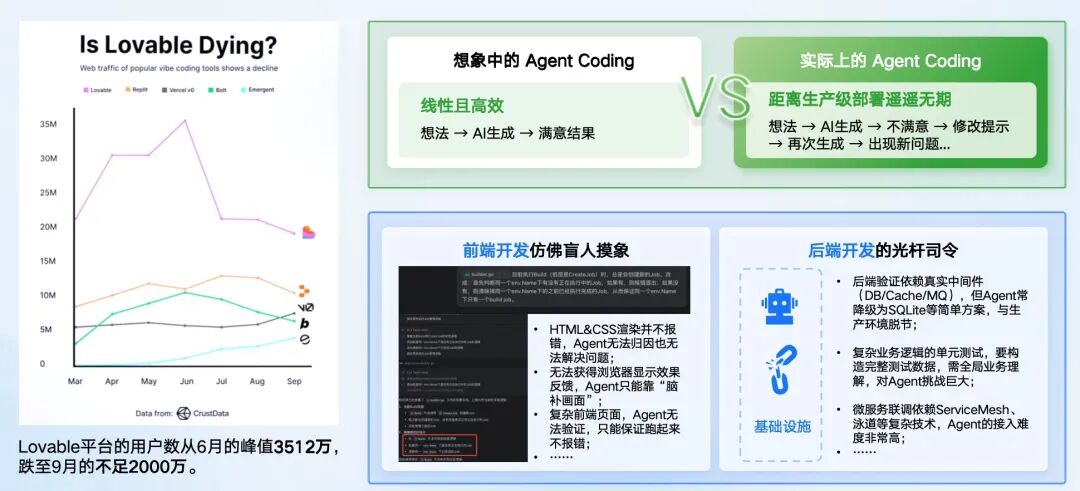
Thus, he believes the first step is to establish “observability” and “controllability”: the system must clearly display each step’s changes and decision paths. Just as programmers and product managers collaborate, they do not simply say, “I made a version; you try it again,” but rather explain, “In version 1.1, we added these features.”
From this perspective, the sudden surge of the “mass influx” Vibe Coding wave in 2025 may have been a technological carnival with the sequence wrong: the technological system is not mature, yet the industry prematurely made promises beyond its capabilities—at least for non-technical users in the C-end.
Real Value Emerges After the Tide Recedes
If we shift our focus from industry hype to more stable long-term trends, Zhang Hailong offers a realistic judgment: Vibe Coding aimed at the general consumer may ultimately shrink into a niche market similar to website building tools or no-code solutions; truly valuable directions are likely to be more deeply tied to professional users, mature models, and the infrastructure of large companies.
However, he also points out that companies that have already raised funds “are at least on the table and will always find something else to do,” even if the final track is not as large as imagined.
He identifies a potential direction worth watching: the so-called “vibe working.” For instance, throwing a batch of data to AI to directly organize the results you need, without the user needing to care whether it involves scripting, manual processing, or model inference. As for the companies currently engaging in vibe coding, whether they can smoothly transition to vibe working in the future—and whether vibe working will also become a game only for large companies—remains to be seen.
However, the fate of Vibe Coding may be best validated in enterprise environments.
Meituan product manager Zou Mingyuan’s analysis is very direct: given the current capabilities of these products, it is difficult to support a completely non-technical user in creating production-level products, but the threshold has indeed been significantly lowered. Previously, achieving “90% capability” was necessary to be a programmer and develop production-level products, but now “60% can produce something.”
At the same time, the applications generated by Vibe Coding have clear “capability boundaries.” Using it to develop a highly concurrent, complex business logic super application, like a large company app, is basically unrealistic. However, not all user demands are at that level; for example, developing a data reporting system for 100 users is where Vibe Coding currently plays a role.
The reality is that current AI coding tools still have significant shortcomings in technology stack limitations, operations, and observability (monitoring, alerts, etc.), which constrain the iteration of existing projects. On the other hand, platforms have already packaged a complete set of “beginner capabilities”—publishing, domain names, networking, version management, PV/UV statistics, dynamic scaling, etc.—sufficient for non-technical employees familiar with their own needs and scenarios within enterprises to create simple, practical projects. In fact, with the help of AI coding, Meituan’s non-technical colleagues have already built over 3,000 applications that are continuously in use, contrasting sharply with the “open-ended free generation” path of Lovable.
From an industry perspective, the number of people in the circle is inherently limited, and a slowdown in traffic is inevitable. However, alongside this decline, the trend of “increasing quality of works” is becoming increasingly evident. As the early noise and purely experimental users exit, what remains are those genuinely using Vibe Coding to solve problems in specific scenarios, especially new “developers” emerging from within enterprises.
Comments
Discussion is powered by Giscus (GitHub Discussions). Add
repo,repoID,category, andcategoryIDunder[params.comments.giscus]inhugo.tomlusing the values from the Giscus setup tool.