AI and Integrated Circuits: Innovations in Computing Power Architecture
Currently, the deep integration of artificial intelligence (AI) and integrated circuits has become a key area in global technology competition, with innovations in computing power chip architecture being crucial. On May 17, the first AI Academicians Forum themed “Leading Chips, Creating the Future” was held in Beijing, marking the establishment of the Beijing Key Laboratory for New Architecture Intelligent Chip Technology. Experts from government, industry, academia, and research gathered to discuss the core technology breakthroughs for intelligent chips in China and to build consensus on independent innovation in computing power.
The forum was guided by the Beijing Municipal Science and Technology Commission and the Management Committee of Zhongguancun Science Park, hosted by the Beijing Key Laboratory for New Architecture Intelligent Chip Technology, and co-organized by Qingwei Intelligent, the Software Research Institute of the Chinese Academy of Sciences, Beijing University of Technology, and the Beijing Academy of Artificial Intelligence. Government officials, academicians, and industry leaders engaged in deep discussions on topics such as the transformation of computing power infrastructure, breakthroughs in core technologies, and the construction of industrial ecosystems, aiming to contribute wisdom to the national 14th Five-Year Plan and promote self-reliance in the computing power sector.
Computing power is the core productivity of the digital age, and an AI computing power base that is independent and controllable is an important support for technological self-reliance. At the opening ceremony, Liu Xiaofeng, Vice Chairman of the 12th National Committee of the Chinese People’s Political Consultative Conference, delivered a speech and proposed four suggestions for high-quality industrial development: focus on forming collaborative research teams to address key shortcomings in algorithms and high-end chips; promote AI to empower the real economy and adhere to technology that benefits the public; strengthen open collaboration to improve the virtuous cycle of technology, industry, and finance; and establish a governance system for AI to ensure safe and controllable technological development, clarifying the direction for healthy industrial growth.
Zhang Jihong, Director of the Beijing Municipal Science and Technology Commission, stated that Beijing gathers leading AI innovation resources in the country, with 148 top global AI talents and a core industry scale exceeding 450 billion yuan, both ranking first in the nation. The establishment of the Beijing Key Laboratory for New Architecture Intelligent Chip Technology is an important layout for consolidating the foundation of independent computing power and strengthening core technology breakthroughs, leveraging the collaborative innovation advantages of the Beijing-Tianjin-Hebei region to drive industrial upgrades with hard-core technology.
Wang Bo, founder, chairman, and CEO of Qingwei Intelligent, mentioned that China’s AI core industry scale has surpassed 1.2 trillion yuan and is expected to exceed 10 trillion yuan by 2030. This forum aims to assess industry trends and share cutting-edge achievements, working together to bridge the “last mile” from technological innovation to industrial innovation.
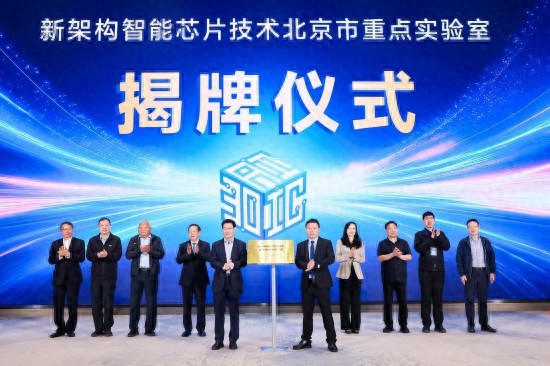
During the event, the unveiling ceremony of the Beijing Key Laboratory for New Architecture Intelligent Chip Technology took place. Zhang Jihong and the laboratory director Ouyang Peng jointly unveiled the laboratory, witnessed by Liu Xiaofeng, Chinese Academy of Sciences Academician Qian Depai, and Chinese Academy of Engineering Academician Li Keqiang, among other guests. Seven experts, including Qian Depai, Wu Nanjian, and Wu Yanjun, were appointed as members of the laboratory’s academic committee. The establishment of this laboratory marks a critical step in China’s exploration of new architectures for intelligent chips and the reconstruction of computing paradigms.
In the keynote report session, academicians, experts, and researchers focused on innovations in underlying architectures, sharing cutting-edge technological achievements and exploring development paths for intelligent chips. Qian Depai, an academician of the Chinese Academy of Sciences and computer expert, presented a report titled “Promoting Computing Power Development through Two Integrations,” proposing a dual-drive strategy of “computing-network integration” and “intelligent-computing integration.” He pointed out that the growth rate of supercomputing has slowed, necessitating new paths for developing systems that combine general and specialized computing, seeking breakthroughs from wafer-level integration and 3D stacking. He vividly suggested constructing a “computing Taobao” model, allowing users to obtain application solutions instead of just computing time, stating, “Let application effectiveness determine success, making computing power a public infrastructure like water and electricity.”
Li Keqiang, an academician of the Chinese Academy of Engineering and an expert in automotive intelligence, focused on the transformative field of smart cars in his report titled “Key Technologies and Applications of the Computing Infrastructure Platform for Intelligent Vehicles.” He systematically elaborated on the core architecture of the “computing infrastructure platform,” which integrates chips, operating systems, and functional software to form a public technology base, creatively proposing a new industrial form of “1.5-level suppliers.” This platform decouples applications from hardware, aiming to break the homogenization of technology and build a self-controllable industrial ecosystem through “vehicle-road-cloud integration,” strengthening the safety foundation of intelligent vehicles.
The wave of artificial intelligence is not only reshaping industries but also profoundly rewriting the way knowledge is produced. Zhu Xinkai, Executive Vice President and Professor at Renmin University of China, presented a report titled “Exploring Research Organizational Forms in Philosophy and Social Sciences in the Era of Artificial Intelligence,” using the study of smart agricultural history as a “testbed” to showcase a new path for philosophy and social sciences to embrace AI. He proposed the creation of the position of “AI Architect for Philosophy and Social Sciences,” establishing strong teams that deeply couple scholars with AI, emphasizing that “philosophy and social sciences should not just be passive observers but should actively become trainers of AI and builders of the theory of ‘intelligent benevolence.’” This cross-disciplinary exploration provides a new paradigm for empowering technological innovation in the humanities and social sciences.
In the afternoon, the New Architecture Intelligent Chip Industry Forum focused on key directions such as brain-like chips, open instruction sets, software ecosystems, and semiconductor manufacturing, discussing paths for the industrialization of technology. In terms of perception, Wu Nanjian, a researcher at the Institute of Semiconductors of the Chinese Academy of Sciences, shared breakthroughs in the “All-Pulse Vision System,” which integrates photon pulse image sensors with pulse neural networks into a single chip, achieving brain-like vision chips with significantly improved processing speed and power consumption compared to similar international results.
In the processor ecosystem, Bao Yungang, Deputy Director and Professor at the Institute of Computing Technology of the Chinese Academy of Sciences, pointed out that the demand for inference computing power in the AI era will reach hundreds of billions, and RISC-V, with its flexible customization advantages, is becoming an ideal choice for the AI chip base. Its leading “Xiangshan” open-source high-performance processor has achieved shipments of tens of thousands of chips and clusters.
Men Chunlei, head of the AI system R&D team at the Beijing Academy of Artificial Intelligence, introduced the “Zhongzhi Flag OS” 2.0 open computing ecosystem. This platform is compatible with various chip architectures and supports large models and embodied intelligent applications, aiming to achieve deep decoupling of models and heterogeneous hardware.
At the application level, Chen Zhijie, Deputy Director of the laboratory and Professor at Beijing University of Technology, showcased an intelligent vision chip for infrared detectors, which achieves adaptive adjustment of precision and bandwidth through a reconfigurable noise-shaping analog-to-digital converter, with a measured power consumption of only 190 milliwatts, providing a mature solution for low-power edge-side infrared intelligent applications.
During the forum, Frost & Sullivan released the “New Computing Power Chip and Future Key Technology Development Report 2026.” The report predicts that by 2030, China’s AI computing power chip market will exceed 1.6 trillion yuan, with an average annual compound growth rate of 50%. It also points out that domestic computing power chips still have shortcomings in computing efficiency, versatility, and scalability, while reconfigurable data flow architectures have development potential, indicating that the next five to ten years will be a critical window for industrial commercialization.
In the roundtable dialogue and the first meeting of the laboratory’s academic committee, experts exchanged views on new architecture chip innovation and full-link ecosystem construction, clarifying the key research directions of the laboratory and proposing a shift from single chip development to overall breakthroughs in architecture systems, enhancing AI-enabled chip agile design verification capabilities, and accelerating the transformation of core technological achievements.
Comments
Discussion is powered by Giscus (GitHub Discussions). Add
repo,repoID,category, andcategoryIDunder[params.comments.giscus]inhugo.tomlusing the values from the Giscus setup tool.